De Havilland Canada Dash 8-400 vs Douglas DC-6
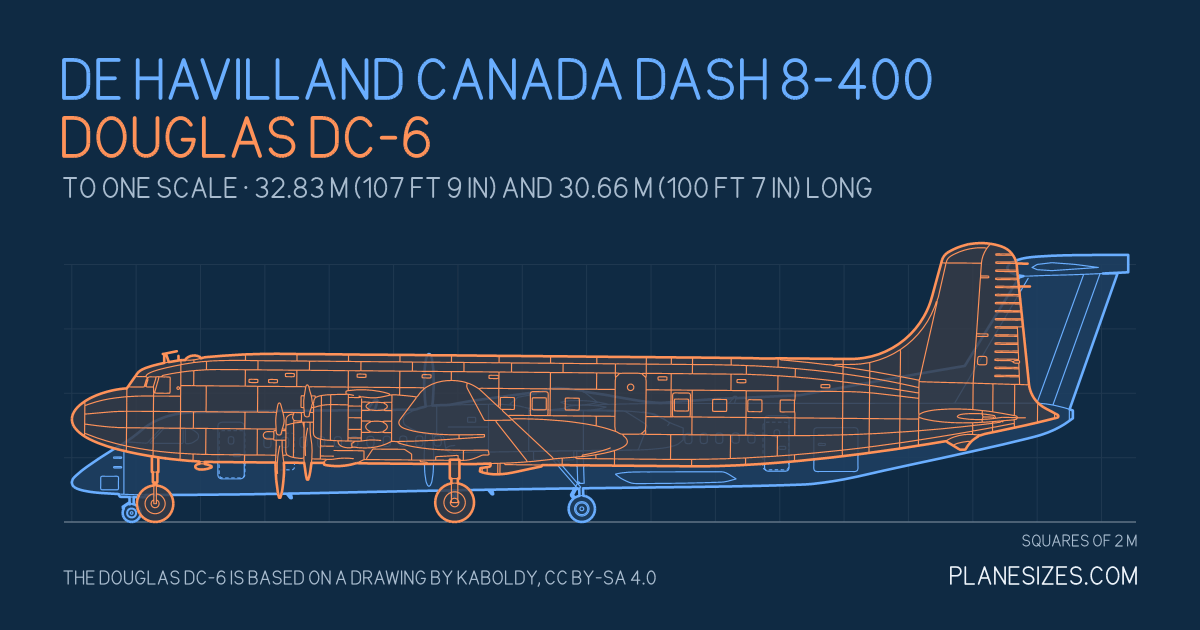
The De Havilland Canada Dash 8-400 and the Douglas DC-6, drawn to scale.
The De Havilland Canada Dash 8-400 is 2.17 m7 ft 1 in longer than the Douglas DC-6. Its wingspan is 7.39 m24 ft 3 in narrower and its tail is 0.36 m1 ft 2 in lower. Its maximum takeoff weight is 19,277 kg (42,500 lb)42,500 lb (19,277 kg) less.
| De Havilland Canada Dash 8-400 | Douglas DC-6 | |
|---|---|---|
| Length | 32.83 m107 ft 9 in | 30.66 m100 ft 7 in |
| Wingspan | 28.42 m93 ft 3 in | 35.81 m117 ft 6 in |
| Tail height | 8.30 m27 ft 3 in | 8.66 m28 ft 5 in |
| Max takeoff weight | 29,257 kg64,500 lb | 48,534 kg107,000 lb |
The Douglas DC-6 is based on a drawing by Kaboldy (credits).
How they compare
- Both are propeller airliners.
- The De Havilland Canada Dash 8-400 is 7% longer than the Douglas DC-6, and its wingspan is 21% narrower.
- For its length, the Douglas DC-6 has the wider wing.
- At maximum takeoff weight, the Douglas DC-6 is 66% heavier than the De Havilland Canada Dash 8-400.
- The De Havilland Canada Dash 8-400 has two turboprops and the Douglas DC-6 four piston engines.
- Both are in the FAA's Airplane Design Group III, so an airport gives them the same clearances.
- ICAO's aerodrome code letter is C for both.
- The De Havilland Canada Dash 8-400 approaches to land at 125 knots and the Douglas DC-6 at 108 knots.
The two aircraft
Share
More comparisons
Douglas DC-6 and ATR 72-600
De Havilland Canada Dash 8-400 and ATR 72-600
De Havilland Canada Dash 8-400 and De Havilland Canada Dash 8-300
De Havilland Canada Dash 8-400 and ATR 42-500
De Havilland Canada Dash 8-400 and De Havilland Canada Dash 8-100
De Havilland Canada Dash 8-400 and Embraer EMB-120 Brasilia