McDonnell Douglas F/A-18 Hornet vs Fairchild A-10 Thunderbolt II
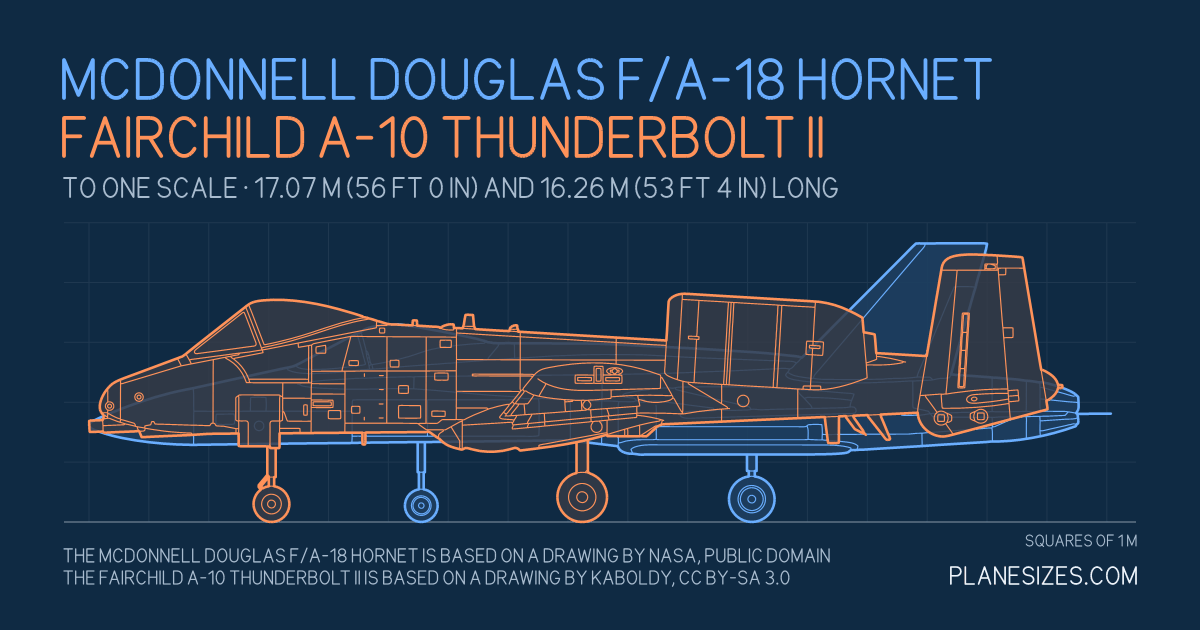
The McDonnell Douglas F/A-18 Hornet and the Fairchild A-10 Thunderbolt II, drawn to scale.
The McDonnell Douglas F/A-18 Hornet is 0.81 m2 ft 8 in longer than the Fairchild A-10 Thunderbolt II. Its wingspan is 6.10 m20 ft 0 in narrower and its tail is 0.19 m0 ft 7 in taller. Its maximum takeoff weight is 2,701 kg (5,950 lb)5,950 lb (2,701 kg) more.
| McDonnell Douglas F/A-18 Hornet | Fairchild A-10 Thunderbolt II | |
|---|---|---|
| Length | 17.07 m56 ft 0 in | 16.26 m53 ft 4 in |
| Wingspan | 11.43 m37 ft 6 in | 17.53 m57 ft 6 in |
| Tail height | 4.66 m15 ft 3 in | 4.47 m14 ft 8 in |
| Max takeoff weight | 25,401 kg56,000 lb | 22,700 kg50,040 lb |
Both are based on drawings by NASA and Kaboldy (credits).
How they compare
- Both are military aircraft.
- The McDonnell Douglas F/A-18 Hornet is 5% longer than the Fairchild A-10 Thunderbolt II, and its wingspan is 35% narrower.
- For its length, the Fairchild A-10 Thunderbolt II has the wider wing.
- At maximum takeoff weight, the McDonnell Douglas F/A-18 Hornet is 12% heavier than the Fairchild A-10 Thunderbolt II.
- Both have two jet engines.
- The McDonnell Douglas F/A-18 Hornet is in the FAA's Airplane Design Group I and the Fairchild A-10 Thunderbolt II in Group II, so an airport has to give the Fairchild A-10 Thunderbolt II wider clearances.
- ICAO's aerodrome code letter is A for the McDonnell Douglas F/A-18 Hornet and B for the Fairchild A-10 Thunderbolt II.
- The McDonnell Douglas F/A-18 Hornet approaches to land at 134 knots and the Fairchild A-10 Thunderbolt II at 140 knots.
The two aircraft
Share
More comparisons
Mikoyan MiG-29 and McDonnell Douglas F/A-18 Hornet
Fairchild A-10 Thunderbolt II and Eurofighter Typhoon
Bell Boeing V-22 Osprey and McDonnell Douglas F/A-18 Hornet
Fairchild A-10 Thunderbolt II and Lockheed Martin F-35A Lightning II
Fairchild A-10 Thunderbolt II and Dassault Rafale
Mikoyan MiG-29 and Fairchild A-10 Thunderbolt II